
12 Team Single Elimination Bracket
Build a 12-team bracket with four first-round BYEs and eleven games. Edit a seeded draw, download blank PNG or SVG templates, and print or save as PDF.
12 teams · 11 games · 4 BYEs
Download blank / seeded templatesBracket
Champion
Ready for the desk or the wall
Printable 12-team bracket templates
Choose a blank sheet for handwritten names or a numbered seeding sheet. Both follow the editor’s default bracket paths.
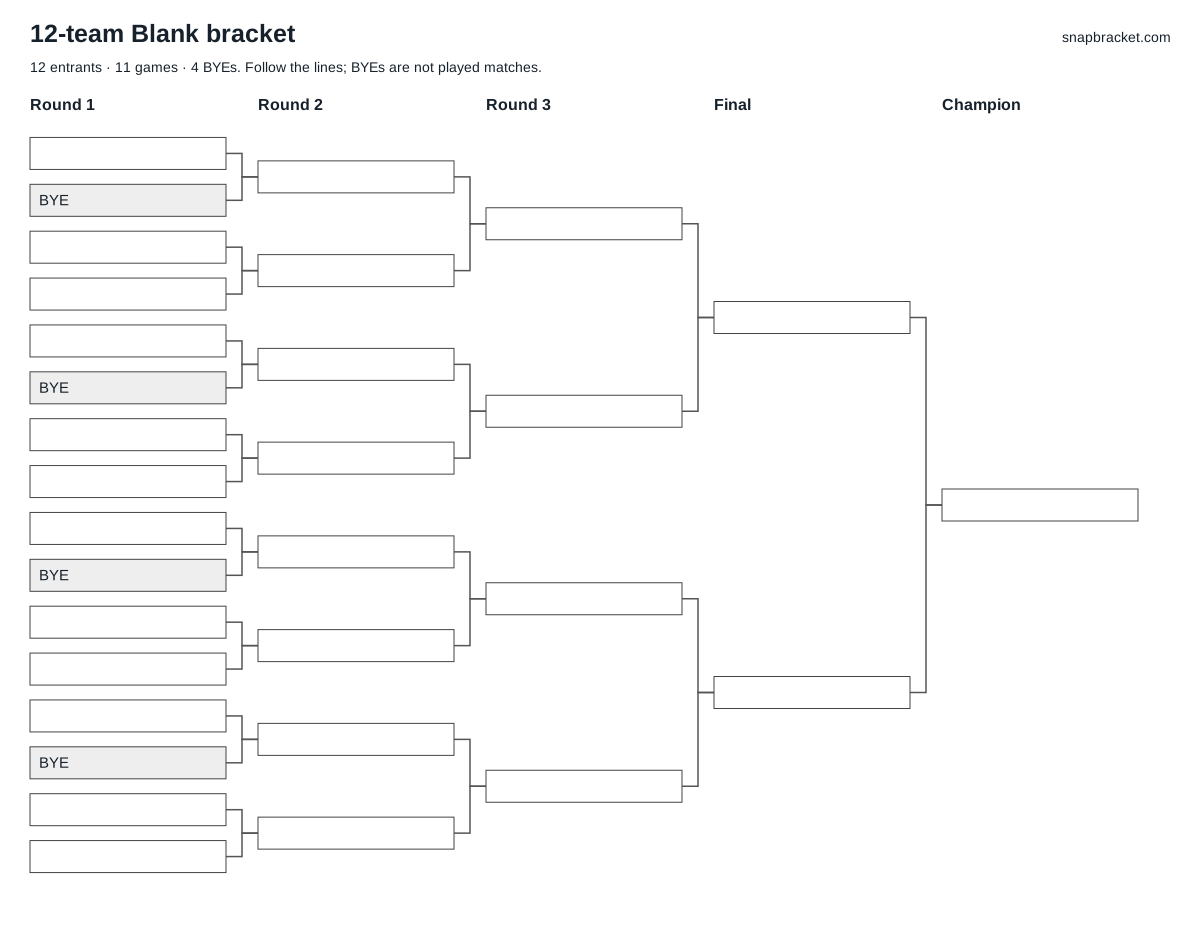
Blank bracket
Write one entrant in each empty first-round box. Keep the marked BYEs empty and advance their opponents.
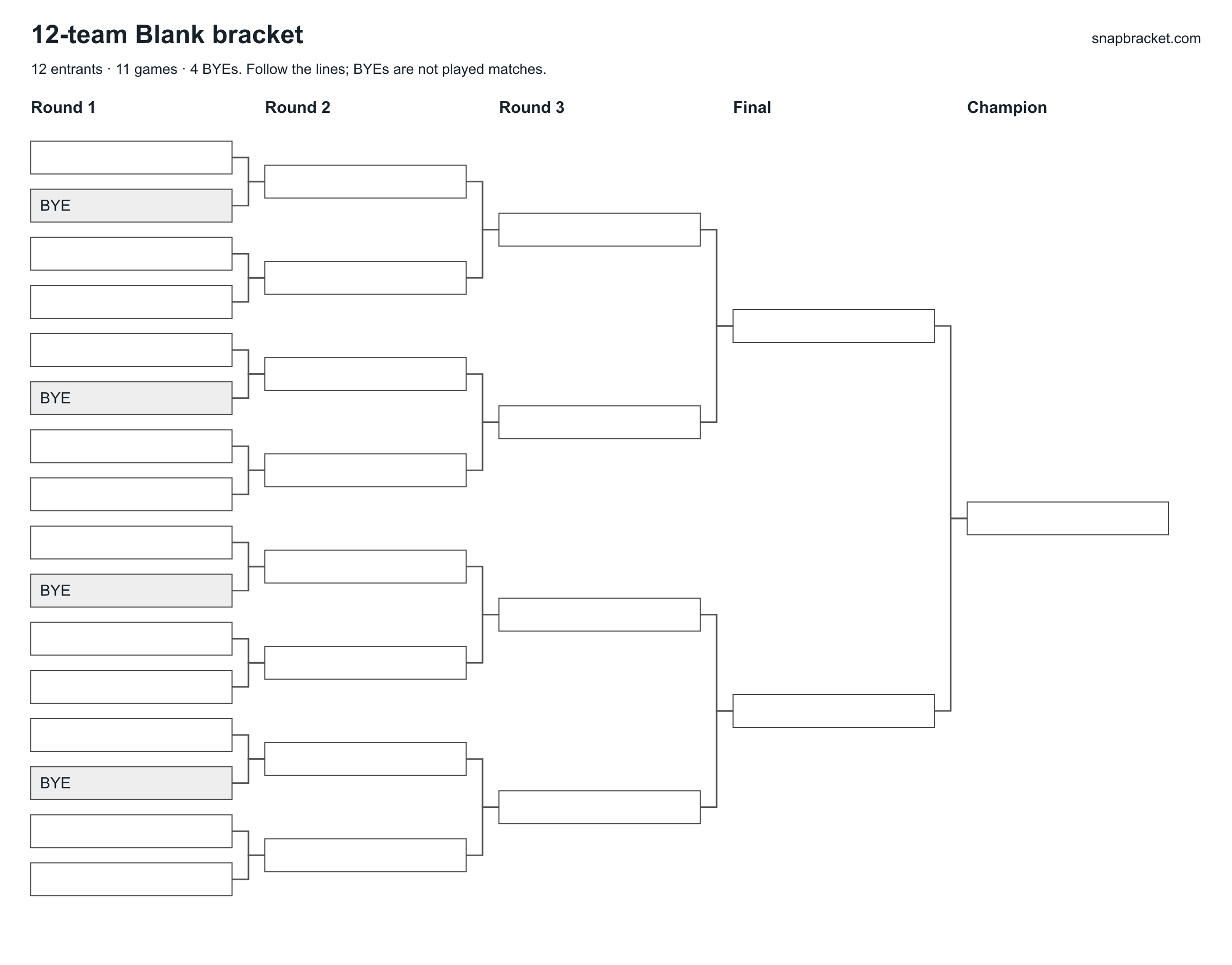
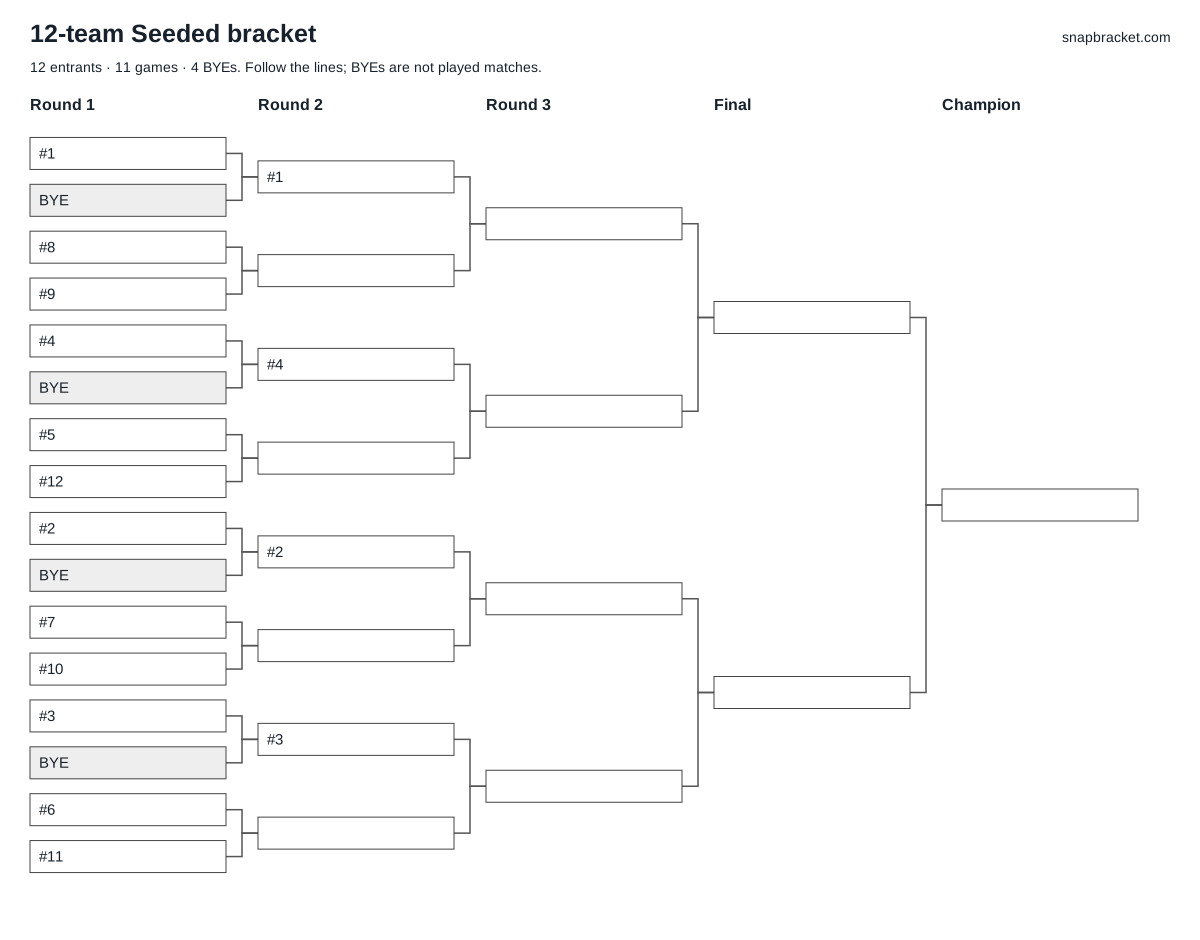
Seeded bracket
Numbers show seed positions, not match results. Put your ranked teams in those positions and follow the fixed paths.
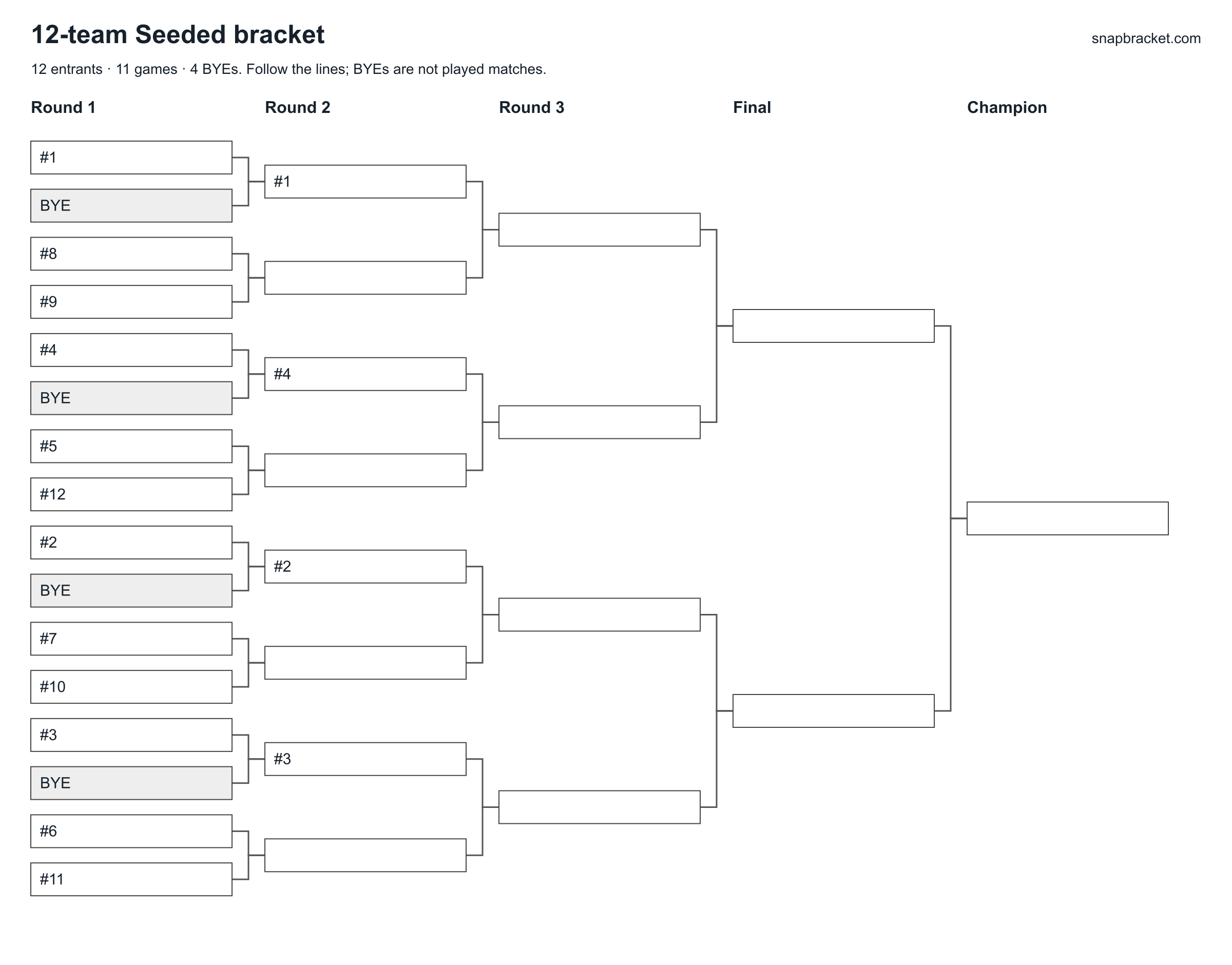
Print opens a separate sheet. Choose A4 or US Letter, landscape, and fit to page. Select Save as PDF in your browser to make a PDF. These downloads are static sheets; use the editor’s PNG export for your entered names and results.
Twelve teams in a sixteen-slot draw
A twelve-team single-elimination tournament needs 11 games across four rounds. Four teams receive first-round BYEs, while the remaining eight play four opening matches. All eight quarterfinalists then compete normally: 4 + 4 + 2 + 1 = 11.
Use this page when registration has closed at twelve entrants. The seeded editor and printable sheets place one BYE in each quarter of the draw, instead of grouping empty slots into one branch.
Four seeds wait for four opening winners
This template awards the BYEs to seeds 1–4. Each waits for a specific opening winner, so the quarterfinals are clear before play begins.
| Quarter of draw | Opening match | Quarterfinal opponent |
|---|---|---|
| A | Seed 8 vs Seed 9 | Seed 1 |
| B | Seed 5 vs Seed 12 | Seed 4 |
| C | Seed 7 vs Seed 10 | Seed 2 |
| D | Seed 6 vs Seed 11 | Seed 3 |
The winners of A and B meet in one semifinal; the winners of C and D meet in the other. Seeds 1 and 2 are in opposite halves. The strongest four seeds cannot meet before the semifinals if each advances.
Set up the editable bracket
Paste twelve names in ranking order, from seed 1 through seed 12. The editor handles the positions and four empty slots; there is no need to type “BYE” as a team name. Compare the first round with the numbered template before starting.
For an unranked event, randomize the draw once and announce the four teams receiving BYEs. Randomizing replaces the current draw and clears selected results. It does not assess team strength.
After each match, select the winner. If an earlier winner changes, later picks along that path are cleared so you can choose them again.
Plan the opening wave and quarterfinals separately
Four playing areas allow all opening matches to run together. After those finish, four quarterfinals can run together, then two semifinals and one final. That is four waves with equal match lengths, before adding breaks and changeovers.
With two playing areas, allow two opening waves, two quarterfinal waves, one semifinal wave and the final: six waves. A single area needs eleven match windows. These are planning examples, not an automatically generated venue schedule.
The four BYE teams should receive quarterfinal reporting times, not opening-round match assignments. Publish a central result board so they know which opponent advances.
Blank sheets, seeding sheets and edited exports
The blank sheet preserves the four BYE labels and gives twelve writable entrant boxes. The seeded version labels positions 1–12 and shows the four automatic advances. Download PNG or SVG, or open the print sheet for A4 / US Letter and browser Save as PDF.
Those files are static templates. To share the actual names and winners you entered, export a PNG from the editor.
FAQ
Why does the bracket have sixteen slots?
Sixteen is the next power of two above twelve. The four unused slots become first-round BYEs.
Do the top four seeds each get two BYEs?
No. Each gets one first-round BYE and enters the quarterfinals. They still need three wins to become champion.
How many wins do the other eight teams need?
Four: an opening match, quarterfinal, semifinal and final.
Can I use twelve names with no rankings?
Yes. Use a random draw and explain the BYE allocation before the tournament starts.
Is this a double-elimination bracket?
No. One played loss eliminates a team. The BYEs do not give teams an extra life.
What if registration reaches sixteen?
Use the 16-team bracket, which has no BYEs and fifteen matches. For eleven entrants, use the 11-team tool and review its placement separately.